
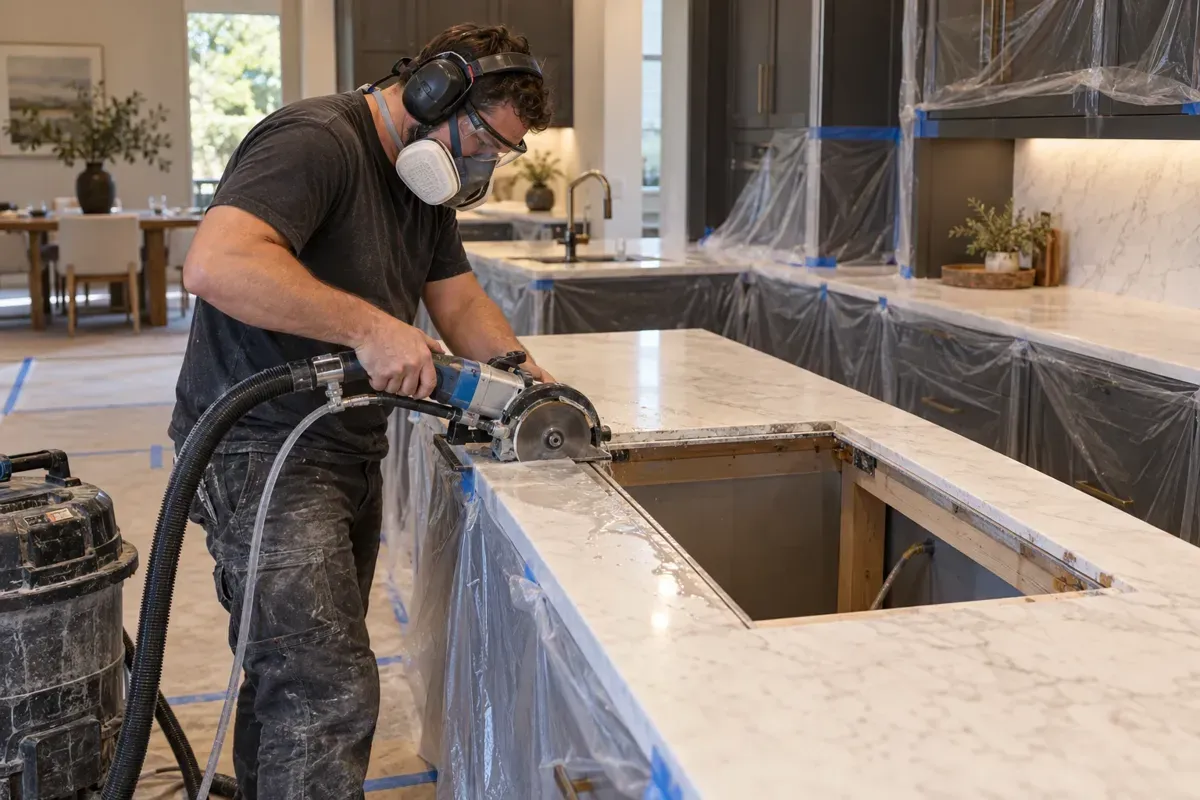
Common reasons for an on-site change
Replacement cooktops, new sinks, additional tap holes and reduced overhangs are common reasons to request an assessment. Each has a different finish requirement: a cooktop rim may hide a cut edge, while a shortened island end remains visible. Describe the final outcome instead of only the cut length.
The installation matters as much as the stone
Walls, splashbacks, joins and cabinet rails can restrict the work. A thick-looking edge may be a mitred build-up rather than a solid section. Photos of the underside and profile help identify these details. If the stone is cracked or inadequately supported, cutting may make the problem worse.
Working inside a finished kitchen
Protection, suitable processing controls, water and slurry management, equipment access and keeping occupants clear all need planning. On-site work should not be described as dust-free or without risk. Different products need different methods, including newer zero-silica surfaces.
When removal or replacement is preferable
Some alterations cannot be made neatly or soundly in place. Moving an opening, filling a large redundant sink hole or changing a poorly fitted waterfall can be better addressed with replacement. We explain these limitations rather than assume retaining the existing stone is always the cheapest overall solution.
Related planning information
Questions, answered.
Can cutting fix a poorly supported benchtop?
No. Support problems need assessment first. Removing more stone from an unsupported or cracked section can make the installation less suitable for modification.
How do I request a quote?
Send your suburb, photos, current and proposed dimensions and the exact appliance or fitting details. We confirm suitability and the written scope before booking.